"Weekly Challenge" May 2026: Spending Time with Jesus in Adoration
Week Beginning May 31, 2026
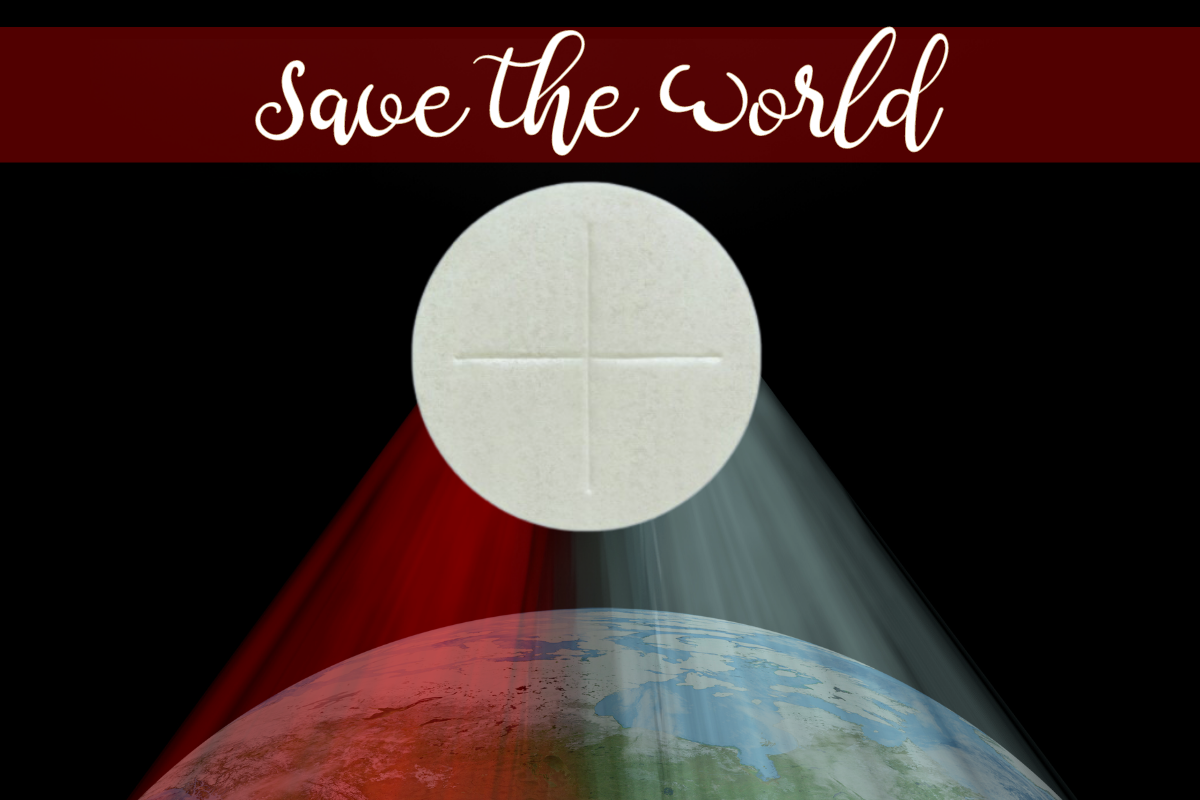
Save the World
Pope Saint John Paul II declares: “The best, the surest and the most effective way of establishing everlasting peace on the face of the earth is through the great power of Perpetual Adoration of the Blessed Sacrament.” Pope Benedict XVI states that “Without adoration, there is no transformation of the world.” Catholic theologian Peter Kreeft says, “Adoration will heal our Church and thus our nation and thus our world.” He continues, “Adoration is more powerful for construction than nuclear bombs are for destruction.” According to the Venerable Fulton Sheen, “A Holy Hour is not a devotion; it is a sharing in the work of redemption.”
Certainly, saving the world is a complicated process. It starts by recognizing God as the Author of All Creation, as the Almighty One who can cast out demons, wash away sins, and calm the seas. We then come before Him with awesome reverence, extreme appreciation, and due humility. Pope Saint Pius X reflects: “Devotion to the Eucharist is the most noble, because it has God as its object; it is the most profitable for salvation, because it gives us the Author of Grace; it is the sweetest, because the Lord is Sweetness Itself.”
Only by spending time with the Lord can we begin to grow in love, to understand His will, and to realize our tiny but critical roles in the story of salvation. “Neither theological knowledge nor social action alone is enough to keep us in love with Christ unless both are proceeded by a personal encounter with Him,” observes the Venerable Fulton Sheen. “Theological insights are gained not only from between two covers of a book, but from two bent knees before an altar. The Holy Hour becomes like an oxygen tank to revive the breath of the Holy Spirit in the midst of the foul and fetid atmosphere of the world.”
Pope Saint John Paul II explains that “Through adoration, the Christian mysteriously contributes to the radical transformation of the world and to the sowing of the Gospel. Anyone who prays to the Savior draws the whole world with him and raises it to God. Those who stand before the Lord are therefore fulfilling an eminent service. They are presenting to Christ all those who do not know him or are far from him: they keep watch in his presence on their behalf.”
The Venerable Fulton Sheen notes: “The motivation for a Holy Hour is reparation. We pray for those who do not pray, we make acts of faith in the Real Presence for those who have lost faith. In a word, we are the victims, like Christ, innocent but one with their guilt in the progressive redemption of mankind.” Pope Saint John Paul II recommends: “Let us take the time to kneel before Jesus present in the Eucharist, in order to make reparation by our faith and love for the acts of carelessness and neglect, and even the insults, which our Savior must endure in many parts of the world.” Saint Peter Julian Eymard suggests: “Let us then love Him for our own sakes. Let us love Him for those who do not love Him, for our relatives and our friends. Let us pay our family’s debt and our country’s. That is what all the saints do; they thus imitate our Lord Who loves His Father for all men and becomes surety for the whole world.”
Saving the world through adoration takes us beyond worship of God, gratitude for His providence, reparation for all sins, and prayerful petition for the needs of others. Eucharistic adoration transforms the world by transforming us. Pope Saint John Paul II teaches us that “Eucharistic worship is not so much worship of the inaccessible transcendence as worship of the divine condescension, and it is also the merciful and redeeming transformation of the world in the human heart” (Dominicae Cenae). By opening our hearts, we open ourselves to becoming agents of salvific change. Servant of God Dorothy Day recounts, “He took upon himself our humanity that we might share in his divinity. We are nourished by his flesh that we may grow to be other Christs.”
Pope Saint John Paul II encourages us to receive that nourishment and to “Visit the Lord in that ‘heart to heart’ contact that is Eucharistic Adoration. Day after day, you will receive new energy to help you to bring comfort to the suffering and peace to the world. Many people are wounded by life: they are excluded from economic progress, and are without a home, a family, a job; there are people who are lost in a world of false illusions, or have abandoned all hope. By contemplating the light radiant on the face of the Risen Christ, you will learn to live as ‘children of the light and children of the day’ (1 Th 5:5), and in this way you will show that ‘the fruit of light is found in all that is good and right and true’ (Eph 5:9).”
Pope Francis challenges us to seek a Eucharistic life: “Let us pray that Catholics place at the center of their lives the Eucharistic Celebration, which transforms human relationships and opens up an encounter with God and their brothers and sisters.” He summarizes: “The Eucharistic Celebration is an encounter with the Risen Jesus. At the same time, it is a way of opening ourselves to the world as He taught us. Each time we participate in the Eucharist, Jesus comes and Jesus gives us the strength to love like He loved, because it gives us the courage to encounter others, to go out of ourselves, and to open ourselves to others with love.”
Venerable Pope Pius XII considers that “The Blessed Eucharist is for Its adorers an inexhaustible source of light and strength.” Pope Saint John Paul II describes how time spent in adoration is important for illuminating our perspective: “Closeness to Christ in silence and contemplation does not distance us from our contemporaries but, on the contrary, makes us attentive and open to human joy and distress and broadens our heart on a global scale. It unites us with our brothers and sisters in humanity and particularly with children, who are the Lord’s dearly beloved.”
“Nothing ever happens in the world that does not happen first inside human hearts,” asserts the Venerable Fulton Sheen. “Unless souls are saved, nothing is saved; there can be no world peace unless there is soul peace. World wars are only projections of the conflicts waged inside the souls of men and women, for nothing happens in the external world that has not first happened within a soul.”
Once our eyes are open to see and our ears are open to hear, our hearts are open to love. Our souls are at peace, oriented toward God. Our minds direct our hands and our feet to do good works as “other Christs” in this modern world. “Not only are we to receive and adore the Eucharist, we must live the Eucharist. We are to let the rays of mercy from the monstrance pass through us and go out through all the world,” reveals Saint Faustina Kowalska. “We are to be icons of mercy, radiating love and mercy to others. There is no greater way to energize ourselves to this task than by spending time in the Presence of the Source of Love and Mercy, Our Lord in the Most Holy Eucharist.”
Saint Teresa of Calcutta comments: “By means of perpetual adoration of Jesus in the Blessed Sacrament, families, parishes and neighborhoods will grow in love of God and one another and will help to bring peace on earth.” The Venerable Fulton Sheen shares that “Our happiest times are those in which we forget ourselves, usually in being kind to someone else. That tiny moment of self-abdication is an act of true humility: the man who loses himself finds himself and finds his happiness.”
Prayerfully consider dedicating an hour of adoration for the love of God, for the benefit of the world, to those who cannot keep watch, to the souls most in need of God’s mercy, to those you love, to those who lost their way, or even simply for yourself.
“‘Pray always!’ the Good Book tells us, and Jesus exhorted us to make sure that our prayer was patient, persistent, and persevering. Eucharistic adoration accomplishes this. It tells the world that ‘we can’t give what we don’t have,’ and that, if we do not constantly turn to God in prayer for His grace and mercy, we’re finished. The best thing people of faith can do is pray,” remarks His Eminence Timothy Cardinal Dolan. “I can’t think of a better place to do that than before our Lord in the Blessed Sacrament.”
As we celebrate the Solemnity of the Most Holy Trinity today, let us recall the words of Saint John: “For God did not send his Son into the world to condemn the world, but that the world might be saved through him” (John 3:17). Your adoration and prayers before our Eucharistic Lord make a difference. Your assignment this week is to pray for an increase of your faith in the great power of perpetual adoration. In the words of the Venerable Fulton Sheen: “Believe the incredible and you can do the impossible.”

Week Beginning May 24, 2026
Say “Yes” to Your Personal Fiat
Fiat — which translates from Latin to English as “let it be done” — is the word we use to describe the Blessed Virgin Mary’s “yes” to the angel Gabriel when asked to become the mother of Jesus. She spent her life humbling herself in adoration, proclaiming the greatness of God, and cherishing His Word in her heart. The strength of her faith, trust, appreciation, and love is demonstrated by her unwavering commitment to let it be done to her according to God’s will.
The Catechism of the Catholic Church teaches us that “To adore God is to praise and exalt him and to humble oneself, as Mary did in the Magnificat, confessing with gratitude that he has done great things and holy is his name” (CCC 2097). Blessed James Alberione elaborates:
“Your role before the tabernacle [is to be]: living lamps before Jesus in the Eucharist; handmaids of honor of the tabernacle and of its Divine Dweller; angels of the Eucharist who receive and who give; souls who hunger and thirst for the bread of the Eucharist and the water of His grace; hearts that share with their Spouse in the Eucharist His desires, His goals, His self-sacrifice for all; the intimate confidantes of Jesus in the Host, listening to His every word of life and meditating on it in your heart, as Mary did.”
Pope Saint John Paul II explains that “Your faith will help you realize that it is Jesus Himself Who is present in the Blessed Sacrament, waiting for you and calling you to spend one special specific hour with Him each week.” His Eminence Timothy Cardinal Dolan notes: “When the first disciples asked Jesus about following Him, he did not say, ‘Come do a bunch of stuff with me.’ Nope — He invited them to ‘Come, stay with me!’ Eucharistic adoration is a great way to answer that invitation.” The Venerable Fulton Sheen observes: “The only time our Lord asked the Apostles for anything was the night He went into agony. Not for activity did He plead but for an Hour of companionship” (Mark 14:32-42, Matthew 26:36-46).
This week, prayerfully consider how you can answer the call to keep watch with Him for one hour. Note that perpetual adoration is dependent upon the dedication of faithful volunteers. Your “yes” to Jesus is needed in order for adoration chapels to remain open and to continue shining the light of Christ upon us every hour of every day.
Saint Catherine of Genoa shares, “Any time spent before the Eucharistic presence, be it long or short, is the best-spent time of our lives.” Pope Saint John Paul II states that “our essential commitment in life is to persevere and advance constantly in Eucharistic life and piety and to grow spiritually in the climate of the Holy Eucharist.” Pope Benedict XV says, “You must propagate veneration of the Most Blessed Sacrament with all your might, for the devotion to the Holy Eucharist is the queen of all devotions.”
Don’t ask yourself if you can spare the time for adoration, but rather ask if you can afford not to. The Venerable Fulton Sheen comments, “It is not particularly difficult to find thousands who will spend two or three hours a day in exercising, but if you ask them to bend their knees to God in five minutes of prayer they protest that it is too long.” Of the 168 hours that God gives to us each week, spending just one of those hours in adoration is a spiritual investment in your future which reaps rewards that are eternal. Saint Alphonsus Ligouri reveals that “Adoration of the Blessed Sacrament consoles a soul far beyond what the world can offer.”
Week Beginning May 17, 2026
Schedule a Private Meeting with Jesus
If you could spend an hour with any person living or dead, who would it be? If you answered Jesus Christ, adoration is your opportunity to get that private audience with him. Saint Josemaría Escrivá says, “Each time you approach the Blessed Sacrament, remember that Jesus has been waiting for you for twenty centuries for this personal visit from you.”
Through adoration of the Blessed Sacrament, we can visit Jesus, enjoy his presence, and develop an intimate connection with him. Saint Thérèse of Lisieux asks, “Do you realize that Jesus is there in the tabernacle expressly for you — for you alone? He burns with the desire to come into your heart.” In the Eucharist, Jesus remains with us as our friend, so that we might remain in the presence of his love.
“Jesus is not an idea, a sentiment, a memory! Jesus is a ‘person,’ always alive and present with us!” exclaims Pope Saint John Paul II. “Love Jesus present in the Eucharist.” He recalls: “It is pleasant to spend time with [Jesus], to lie close to his breast like the Beloved Disciple and to feel the infinite love present in his Heart” (Ecclesia de Eucharistia). He notes, “Jesus waits for us in this sacrament of love” (Dominicae Cenae).
Our friendship with Jesus grows as we spend time in his Eucharistic presence. Jesus tells his disciples, “I no longer call you slaves. … I have called you friends” (John 15:15). Saint Alphonsus Liguori suggests: “Good friends find pleasure in one another’s company. Let us know pleasure in the company of our best Friend, a friend who can do everything for us, a friend who loves us beyond measure. Here in the Blessed Sacrament we can talk to him straight from the heart.”
Pope Benedict XVI explains that “Communicating with Christ demands that we gaze on him, allow him to gaze on us, listen to him, get to know him. Adoration is simply the personal aspect of Communion.” He elaborates: “Through this gaze of adoration, he draws us toward himself, within his mystery, through which he wants to transform us as he transformed the Host.”
The Venerable Fulton Sheen welcomes us to have authentic encounters with Jesus during our Holy Hours. He remarks, “Some spiritual writers recommend a mechanical division of the hour into four parts: thanksgiving, petition, adoration, reparation.” Instead, he proposes, “This is unnecessarily artificial. An hour’s conversation with a friend is not divided into four rigid segments or topics. The Holy Hour is not an official prayer; it is personal.” He reminds us that “The purpose of the Holy Hour is to encourage deep personal encounter with Christ. The holy and glorious God is constantly inviting us to come to Him, to hold converse with Him, to ask for such things as we need and to experience what a blessing there is in fellowship with Him.”
Saint Maximillian Kolbe recommends that we “tell Him we love Him. We might ask Him what He wants of us, what are His wishes. Sometimes we might ask Jesus something for ourselves and something for others. One can speak to Jesus as brother to brother, as friend to friend, more so, since it often happens that men do not understand us, whereas Jesus understands each of us always.” Saint John Vianney shares that “When we speak to Jesus during our adoration of the Blessed Sacrament with simplicity and with all our heart, He does like a mother who holds her child’s head with her hands and covers it with kisses and caresses.”
“There is more sweetness in one hour of prayer before Jesus in the Blessed Sacrament than in all the world’s crowded theaters, and brilliant drawing rooms, and giddy diversions, and social gatherings,” observes Saint Gabriel Possenti. Saint Padre Pio of Pietrelcina muses: “A thousand years of enjoying human glory is not worth even an hour spent in sweetly communing with Jesus in the Blessed Sacrament.”
The Venerable Fulton Sheen teaches us, “Prayer begins by talking to God, but it ends by listening to Him. In the face of Absolute Truth, silence is the soul’s language.” Every Holy Hour is unique, and how we choose to adore, to study, to pray, and to reflect is individual. “In vocal prayer we go to God on foot. In meditation we go to God on horseback. In contemplation we go to God in a jet,” he conveys. Regardless of your choices, he assures us, “It’s impossible to lose your footing when you’re on your knees.”
Pope Benedict XVI urges us to “Go to the encounter with Him in the Blessed Eucharist, go to adore Him in the churches, kneeling before the Tabernacle: Jesus will fill you with His love and will reveal to you the thoughts of His Heart. If you listen to Him, you will feel ever more deeply the joy of belonging to His Mystical Body, the Church, which is the family of his disciples held close by the bond of unity and love.” However, he cautions that “God is waiting for us in Jesus Christ in the Blessed Sacrament. Let us not leave him waiting in vain! Let us not, through distraction and lethargy, pass by the greatest and most important thing life offers us.”
Don’t miss out on this amazing offer to receive your private audience with our Lord. This week, prayerfully consider how you can prioritize adoration in your schedule. Search for adoration times near you. Or, become an adorer at the Divine Mercy Adoration Chapel at Saint Joseph’s Church in Greenwich Village. There, you can select your hours daily, weekly, bi-weekly, or monthly. You can make a one-time commitment, a perpetual commitment, or a commitment for any length of time you choose. You can also sign up to serve as a substitute adorer for times that are convenient for you. Pope Saint John Paul II stresses that “The Eucharist is a priceless treasure: by not only celebrating it but also by praying before it outside of Mass we are enabled to make contact with the very wellspring of grace.”
Week Beginning May 10, 2026
Become What You Behold
The Catechism of the Catholic Church teaches us:
“The Church knows that the Lord comes even now in his Eucharist and that he is there in our midst. However, his presence is veiled. Therefore we celebrate the Eucharist ‘awaiting the blessed hope and the coming of our Savior, Jesus Christ,’ asking ‘to share in your glory when every tear will be wiped away. On that day we shall see you, our God, as you are. We shall become like you and praise you for ever through Christ our Lord’” (CCC 1404).
Saint Paul encourages us to become what we behold: “All of us, gazing with unveiled face on the glory of the Lord, are being transformed into the same image from glory to glory, as from the Lord who is the Spirit” (2 Corinthians 3:18). The Venerable Fulton Sheen says, “During a Holy Hour we grow more and more into His likeness.” Saint Francis De Sales remarks: “As mountain hares become white in winter because they neither see nor eat anything but snow, so by adoring and feeding on beauty, purity and goodness itself in the Eucharist you will become altogether beautiful, pure, and good.”
You can’t bask in the sun without absorbing its warmth and reflecting the light of its rays. Similarly, you can’t adore the Blessed Sacrament without absorbing the divine rays of mercy and reflecting the love of our Lord. Pope Francis observes that “the Eucharist is a ray of light of the unsetting sun that is the Risen Jesus Christ.”
The privilege of adoring the holy Eucharist provides a powerful opportunity for spiritual growth. Blessed James Alberione suggests that “Frequent encounters and familiar conversation with Jesus produce friendship, resemblance, and identity of thought, feeling, and willing with Jesus.” Saint Alphonsus Liguori states: “Know also that you will probably gain more by praying fifteen minutes before the Blessed Sacrament than by all the other spiritual exercises of the day. True, Our Lord hears our prayers anywhere, for He has made the promise, ‘Ask, and you shall receive,’ but He has revealed to His servants that those who visit Him in the Blessed Sacrament will obtain a more abundant measure of grace.”
In Mysterium Fidei, Pope Saint Paul VI concurs: “How great is the value of conversation with Christ in the Blessed Sacrament, for there is nothing more consoling on earth, nothing more efficacious for advancing along the road of holiness!” He explains: “Christ is truly the Emmanuel, that is, God with us, day and night, he is in our midst. He dwells with us full of grace and truth. He restores morality, nourishes virtue, consoles the afflicted, strengthens the weak.”
In addition to the many graces and blessings that come from adoration, we can also obtain indulgences. “A partial indulgence is granted for the faithful, who visit the Most Blessed Sacrament to adore it; a plenary indulgence (under the usual conditions) is granted if the visit lasts for at least one half an hour” (Enchiridion of Indulgences).
Every minute we spend with Jesus on earth prepares our everlasting souls for heaven. Saint Gertrude the Great notes: “I understand that, each time we contemplate with desire and devotion the Host in which is hidden Christ’s Eucharistic Body, we increase our merits in heaven and secure special joys to be ours later in the beatific vision of God.” Our souls hunger for “the living bread that came down from heaven” (John 6:51). Saint Teresa Benedicta of the Cross urges us to “make room in our life for the Eucharistic Lord, so that He can change our life into His.”
This week, reflect upon the ways that Eucharistic adoration can help you progress on your spiritual journey. Prayerfully consider becoming what you behold as an adorer right here in Manhattan, or search for adoration times near you. Saint Philip Neri asks, “Can you feel the fragrance of Paradise which diffuses Itself from the Tabernacle?”
Week Beginning May 3, 2026
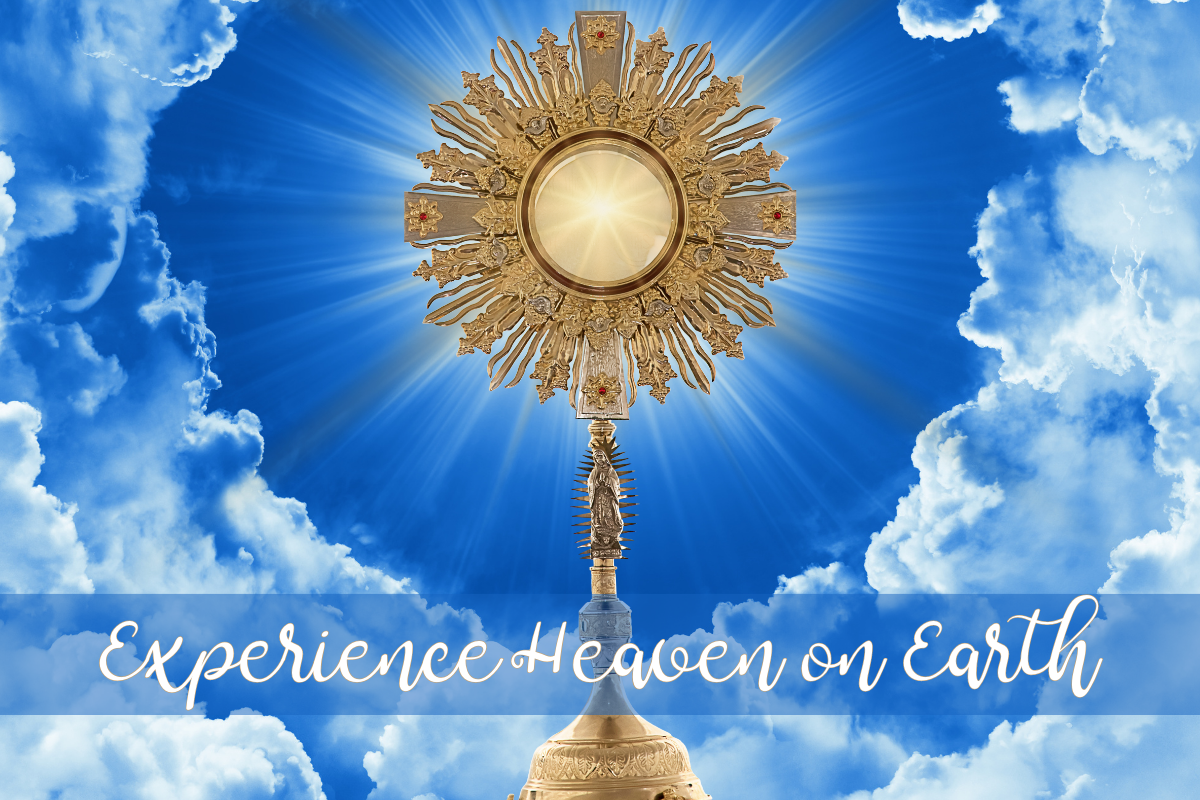
Experience Heaven on Earth
“God is really present in the consecrated Host as He is in the glory of heaven,” teaches Saint Paschal Baylon. When we adore the Body, Blood, Soul, and Divinity of our Lord in the holy Eucharist, we begin doing here on earth what we hope to do for all of eternity. In the quiet of an adoration chapel or church, we enjoy the blissful peace of being in the presence of God. Saint Frances Xavier Cabrini states, “In the shadow of Your tabernacle I can enjoy that intimate union with You which is paradise on earth.” Saint John Vianney adds, “We should want to stay always at his feet; it would be a foretaste of heaven; everything else would become insipid to us.”
Pope Saint John Paul II notes: “In this silence of the white Host, carried in the Monstrance, are all His words; there is His whole life given in offering to the Father for each of us; there is also the glory of the glorified body, which started with the Resurrection, and still continues in Heavenly union.”
Saint Melito of Sardia elaborates on the pledge of salvation: “Come, then, all you nations of men, receive forgiveness for the sins that defile you. I am your forgiveness. I am the Passover that brings salvation. I am the lamb who was immolated for you. I am your ransom, your life, your resurrection, your light; I am your salvation and your king. I will bring you to the heights of heaven. With my own right hand I will raise you up, and I will show you the eternal Father.”
The Catechism of the Catholic Church explains that “by the Eucharistic celebration we already unite ourselves with the heavenly liturgy and anticipate eternal life, when God will be all in all” (CCC 1326). At every moment in all the tabernacles of the world, we can encounter the Lord through his presence in the Blessed Sacrament.
“It is highly fitting that Christ should have wanted to remain present to his Church in this unique way. Since Christ was about to take his departure from his own in his visible form, he wanted to give us his sacramental presence; since he was about to offer himself on the cross to save us, he wanted us to have the memorial of the love with which he loved us ‘to the end,’ even to the giving of his life. In his Eucharistic presence he remains mysteriously in our midst as the one who loved us and gave himself up for us, and he remains under signs that express and communicate this love” (CCC 1380).
“Our Lord is hidden there in the tabernacle, waiting for us to come and visit Him, and make our requests to Him,” says Saint John Vianney. “In heaven, where we shall be glorious and triumphant, we shall see Him in all His glory. If He had presented Himself, before us in that glory now, we should not have dared to approach Him; but He hides Himself like a person in prison, who might say to us, ‘You do not see Me, but that is no matter; ask of Me all you wish and I will grant it.’” Saint Faustina Kowalska proclaims: “O blessed Host, enchantment of all heaven, though Your beauty be veiled and captured in a crumb of bread, strong faith tears away that veil.”
Saint Teresa of Avila encourages us that “In the presence of Jesus in the holy Sacrament, we ought to be like the blessed ones in heaven before the Divine Essence.” This week, prayerfully consider experiencing a taste of heaven on earth by becoming an adorer right here in Manhattan, or search for adoration near you. Saint Luigi Guanella shares, “The Holy Eucharist visited us daily becomes our heaven.” Saint Peter Julian Eymard advises:
“Look upon the hour of adoration assigned to you as an hour in paradise. Go to your adoration as one would to heaven, to the divine banquet. You will then long for that hour and hail it with joy. Take delight in fostering a longing for it in your heart. Tell yourself, ‘In four hours, in two hours, in one hour, our Lord will give me an audience of grace and love. He has invited me; he is waiting for me; he is longing for me.’”